

At time of writing – the 12th of December 2025, the UN’s 30th Conference of Parties (COP30) has been over for 20 days. Read this article by The Guardian for a debrief on all of the goals and terminology seen in discussions of the climate summit. This particular conference has seen many updates and has been regarded as extremely divisive, with there being a literal fire occurring at COP30 – an upsetting sort of ironic. This year’s conference took place in Belem, Brazil in the Amazon rain-forest. Which, considering that the rain-forest is 18% deforested, and not meant to reach 20% deforestation or more, seems as though a strange location to build a large UN conference venue. Although, personally, It’s more worth considering what decisions and agreements have arisen out of the discussions.
Much of what was expected to be seen at this COP involved far more delineation over previous agreements and negotiations. This years conference hardly saw any new discoveries or revolutionary proposals as to how to more effectively slow down and put an end to the climate crisis. In truth, we have an incredible amount of information on how to use renewable energy, better agricultural use, and son on and so forth. Far more prevalent were discussions on furthering the follow through and ramping up of those ideas.
Perhaps the most mentioned information to come out of this year’s COP is a text that takes on the ‘global goal on adaptation’, which finally now ratifies measurable and tangible indicators used to track countries progress on climate change. Inarguably a step in the right direction given that there haven’t been these sorts of indicators present since the Paris Agreement was put into place in 2016. Moreover, a target set at COP30 to triple finance climate adaptation in developing countries by 2035. This is a fairly normal response considering the large amount of pushing from developing countries like Small Island States and the alliance between China, India, and Saudi Arabia. To read more in – depth about that, I’d recommend my previous article discussing COP30. In any case, the tripling of finance comes as a need for funding to build infrastructure to protect against climate hazards. Natural disasters, floods, agricultural droughts continue to plague many developing nations due to climate change.
However, it certainly isn’t all sunflowers and daisies as far as the climate summit went, there was a large fire. Granted, it was due supposedly to a faulty microwave or other electrical device, and all were evacuated safely and the fire was put out in about six minutes. What is drastically more inflammatory about this years conference is the indefensibly weak final text that sprung forth from the conference. That being that for a time, the agenda for COP30, the globally largest climate conference, headed by the United Nations with the express goal of solving the climate crisis – did not once mention a road-map in transitioning away from fossil fuels. And their final text seemingly didn’t mention deforestation, which only worsens the irony of the conference being held in the Amazon rain-forest. Irregardless, Brazilian President Luis Inacio Lula Da Silva remains steadfast in his fight to reduce dependency on oil and gas in Brazil.
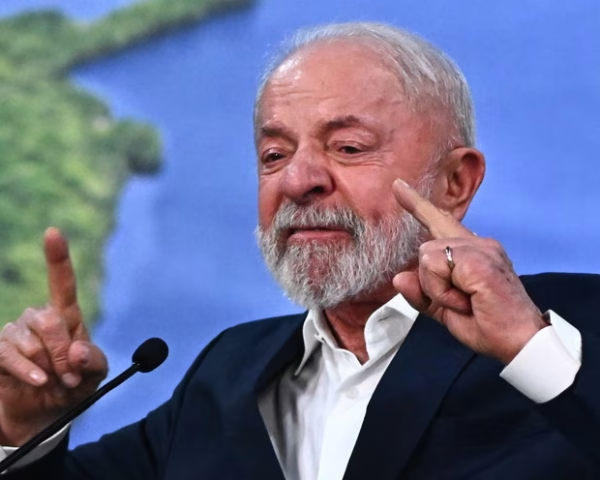
The Guardian writes, “The Brazilian president, Luiz Inácio Lula da Silva, has told Cop30 delegates that he will take his fossil fuel transition roadmap to the G20 in Johannesburg this week to campaign for it, despite reports that petrostates have said they will not accept the plan.” (Harvey, Watts, Nov. 21, 2025). In truth, this is only one of many problems that ran rampant throughout this years climate conference. As for example, the very strict hierarchal system of how the final text at a COP is written to delineate between active and inactive language, this year had significantly more inactive language. In general, it feels like not very much has gotten done. Anyone who gives a care about the environment and our policy in regard to it – myself included – could surely go on for several more ginormous paragraphs. But what’d be the good in implanting a sense of hopelessness in whoever’s poor, desolate soul may be reading this.
It becomes apparent in times like the ones we find ourselves in that these problems are still very purtinant. And one should keep a keen eye on where our countries various governments and leaders are steering us. Whether or not you live in Springfield or Suriname, climate change matters. It matters whether or not we choose to acknowledge it, and whether or not politicians choose to face it or put the interests of the agriculture and fossil fuel industries before it. Times are dire, but we can still make progress. It’s just becoming less clear how, but hope is not lost. Much to come in the environmental world, one might suspect.
Happy Holidays, everybody!