

Saturday, April 15, 2026, the first municipal election held in 21 years was undertaken in Deir Al-Balah, in central Gaza and in the occupied West Bank.
Current sitting Palestinian President Mahmoud Abbas was elected in 2005, and was at the time set to serve a four year term.
However, when Hamas seized control of Gaza following wins in parliamentary elections and became the dominant force, the Palestinian Authority (the internationally recognized representative of the Palestinian people) were ousted. Gaza had not held a presidential or legislative election since 2006.
This most recent election seems to suggest somewhat of a return to power for the Palestinian Authority. Candidates of this race were required to accept the program of the Palestine Liberation Organization, the group which leads the Palestinian authority. The program itself demands the recognition of Israel and the renunciation of armed struggle. This stipulation is most likely what led to the non-participation of Hamas and other factions.
They were instead dominated by independent runners and Fatah, the faction which leads the Palestinian Authority, and were victorious in the races. However, despite their seeming favorability, this may not be the case.
As support for the P.A. (Palestinian Authority) and President Abbas has significantly weakened over the course of years of frustration with the advances of Jewish and Israeli settlers and occupants. NPR writes, “Elections now allow voting for individuals rather than slates. With faith in political parties low, they were less important than families and clans in campaigning” (NPR, Apr. 27, 26).
These elections also saw relatively low turnout in both Deir Al-Balah and the West Bank, 23% and 56% respectively. However, challenges which may have led to this turnout include outdated civil registry records and mass displacement.
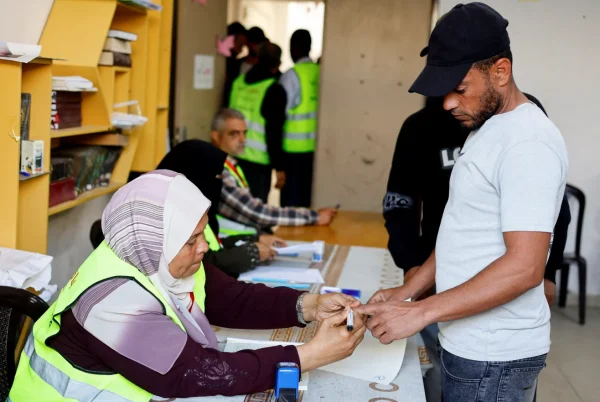
These causes are certainly likely, as the effects of the 2-year long conflict between Hamas and Israel can be somewhat seen amongst the details of this election cycle. As Deir Al-Balah, as is the case with the vast majority of infrastructure in the strip, has been devastated by the conflict. And, as many would-be polling sites such as schools are no longer standing, many voting sites were held in tents.
And, as aforementioned, much of the general support for the broader political parties related to the P.A. and Abbas, while these elections victors, is ultimately lessened. In part due to the very felt effects of how ground invasions and destruction caused by the violence of the war and the attacks of Israeli settlers.
The P.A. describes this election cycle as more of a symbolic first step towards statehood. An Al Jazeera article writes, “The vote in central Gaza’s Deir el-Balah was a largely symbolic “pilot” election, Palestinian Authority officials said, intended to show that Gaza was an inseparable part of a future Palestinian state” (NPR, Apr. 26, 26).




![The latest Republican criticism of comedian and TV host Jimmy Kimmel and call to kick him off the air came from United States First Lady Melania Trump [File: AFP] https://www.aljazeera.com/news/2026/4/27/melania-trump-blasts-kimmel-calls-on-abc-to-take-stand-against-comedian](https://northmontthunder.com/wp-content/uploads/2026/05/afp_69ef8a0faee1-1777306127.webp)