
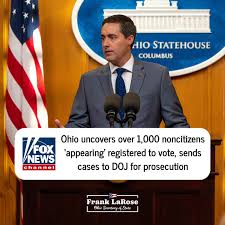
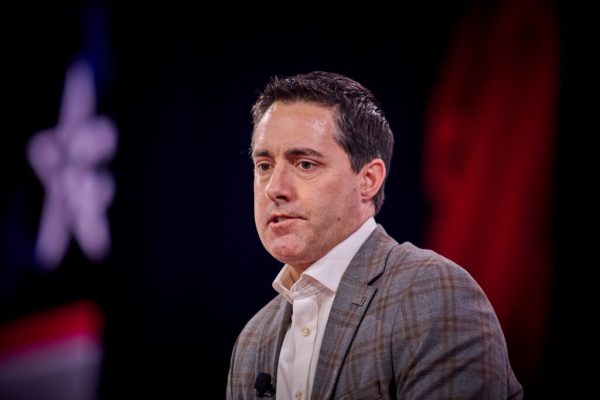
In Columbus Ohio early last week, Ohio Secretary of State Frank LaRose shared personal data estimating at about 8 million Ohio resident voters with the federal Department of Justice. Ben Kindel, LaRose’s press secretary, stated that LaRose’s office shared voter’s driving license records, dates of birth and the last four digits of their social security numbers; this information was confirmed to be out in February. Secretary of State LaRose wrote to Assistant Attorney General Harmeet Dhillon on February 13, detailing his plans to accomplish the goal of a federal demand for states’ voting records.
This information including President Donald Trump’s administration team has been demanding state voter records for months, and Ohio is one of the 12 states complying with this demand. In February, the DOJ(U.S. Department of Justice) sued Washington D.C. and 29 other states for not complying with this demand, refusing to provide their lists, with concerns on whether their data would be put out for others to see and whether the data would be protected by the government or not.
Reportedly, on WDTN News, Representative Allison Russo states,“When Ohioans are required to provide private personal information to participate in our democracy, they deserve absolute confidence that their data will be protected”(Mar. 7,2026). “I have grave concerns about how this information could be used or manipulated in ways that undermine the will of American voters”(Mar. 7,2026).
Soon after Allison Russo’s statement, LaRose commented,“The list I am sending you, however, is a static snapshot,” LaRose wrote in his letter(Mar.7, 2026). “This means that at no point in time will I be able to give the Department a demonstrably perfect image of our database. Voter list maintenance is always a work in progress”(Mar. 7,2026).
The 8 million voter records come after LaRose agreed to share the information of 1,000 randomly selected diver license records to the Department of Homeland Security in early December. Because of this exchange, Ohio received updated access to the Systematic Alien Verification for Entitlements(SAVE) system, which accordingly, is a federal database based on tracking citizenship for public benefits. Voting rights groups have reported being concerned about using the SAVE database to determine voter eligibility.
A report from the U.S. commission on Civil Rights during President Donald Trump’s first term serving, cautioned states against relying on SAVE in voting record data as it is “not a comprehensive list of U.S. citizens.”








![The latest Republican criticism of comedian and TV host Jimmy Kimmel and call to kick him off the air came from United States First Lady Melania Trump [File: AFP] https://www.aljazeera.com/news/2026/4/27/melania-trump-blasts-kimmel-calls-on-abc-to-take-stand-against-comedian](https://northmontthunder.com/wp-content/uploads/2026/05/afp_69ef8a0faee1-1777306127.webp)